
Decision Room
Get real challenge on the big decision before you commit the company to it.
The higher you sit, the fewer people tell you that you are wrong, so the biggest decisions are often made with too few voices in the room. Decision Room is your own digital advisory board. Six AI advisers, each responsible for one angle such as the numbers, the customers, operations, legal and the owners, challenge your case, and a chair turns their challenge into a recommendation. You leave with a choice you can explain and a two-page summary you can put on the table in your leadership team.
Evidence before argument. Alternatives before commitment.
Already have access?
Log in to Decision RoomOne critical decision
Strategic or commercial
Evidence and alternatives
Examined before commitment
Human accountability
Clear rationale and named ownership
The decision room method
Built around the choice, not the presentation.
The room makes the evidence, assumptions and alternatives visible before you commit. AI drives the analysis and the challenge. The decision remains yours.
What enters
- Evidence
- Assumptions
- Real alternatives
- Stakeholder perspectives
Flagship
Decision Room
Structured challenge, practical analysis and a clear decision record
What leaves
A clear decision
What leadership chooses
A clear rationale
The evidence and trade-offs that support the choice
Named ownership
Who moves it forward

What leadership leaves with
A decision people can explain and act on.
The room closes with a clear choice, a visible rationale and a shared understanding of what happens next. It all comes together in a two-page decision summary you can print and take into your leadership team or board meeting.
The decision
A precise statement of what has been chosen.
The rationale
The evidence and trade-offs that support the choice.
The alternatives
A record of the options considered and why they were not chosen.
The ownership
Named responsibility and the first actions after the decision.
What you take with you
Every decision ends in a summary you can take into the leadership team.
The summary brings together the decision, the chair's recommendation, the paths on the table, the advisers' points, your own decision, the assumptions and the next steps. It fits on two A4 pages, and you can print it or save it as a PDF from your journal, even weeks later.
The example is fictional. Eksempel Emballage A/S, the figures and the case do not exist.
When to use the room
Use it when leadership cannot afford a vague answer.
The issue may be strategic or commercial. What matters is that it requires a real choice, has consequences and needs visible ownership.
- 01A strategic choice with competing alternatives
- 02A commercial decision with significant consequences
- 03A leadership team that needs clarity and action
From practice
A product collaboration that reached Danish retail.
Result
A credible market example to build on.
The work created a credible market example that the company could use in further commercial conversations.
- 01
The situation
The company needed credible case studies from a recognised manufacturer to demonstrate how its sustainable product could work in the market.
- 02
The work
Upscale Strategy developed the commercial strategy and narrative and opened meetings with relevant senior decision makers.
- 03
The decision
The work contributed to a product collaboration with a strong Danish food brand and a launch in Danish retail.
How a session works
A focused process from question to ownership.
- 01
Present the decision
Describe the decision, what you are considering, why it is now and where you stand yourself. The chair seats the six of the nine advisers the matter requires and explains why.
- 02
The advisers present their perspectives
Each adviser puts their sharpest perspective on the table, from their own seat: the numbers, the customers, operations, legal, the owners.
- 03
Work the room
You answer, question and push back, exactly as at a real table. No conclusion without you.
- 04
The chair sums up the room
A recommendation, assumptions to watch, and all of it saved in your journal.
See it before you buy
The whole deliverable, not a taster.
This is what you hold when the room closes. The example is built on a typical situation in a mid-sized company, not a client case, and the texts are shortened. But the sequence and the headings are exactly what the product delivers.
The decision, as the leader put it forward
Our largest customer accounts for 34 percent of revenue and is demanding an 8 percent price reduction to renew. Do we give it to keep them, or hold the price and risk losing them?
The advisers selected by the chair
Karen Bruhn
chief financial officer
the numbers, and what they do not show
Rafael Moreno
chief commercial officer
the customer, the price and what the market will pay
Helena Lindqvist
chief strategy officer
where you play, and what you say no to
Mads Kjeldsen
chief operating officer
whether you can deliver what you promise
Birgitte Falk
owner representative
the owners' patience and appetite for risk
Sofie Winther
general counsel
the contract, the lock-in and the precedent






The chair seats six of the nine for each case and explains the choice. Here because the case is commercial, has significant financial consequences, affects operations and may set a precedent for other customers.
The advisers are AI personas, and each adviser assesses the case from a clear professional mandate: the numbers, the customer, the playing field, operations, the owners, the contract. They do not replace your accountant, lawyer or board. Legal, financial and other specialist judgements from the room must be checked with a professional before you commit.
The exchange
Read the full exchange, six repliesRead the full exchange, six replies
Karen Bruhn · chief financial officer
Eight percent on 34 percent of revenue is not a discount, it is your entire margin on that customer and probably more. Before we discuss giving or holding: what is the contribution margin on that specific customer today, and what happens to cash if they leave on three months' notice?
Rafael Moreno · chief commercial officer
You have framed this as yes or no to eight percent, and that is how you lose. Ask instead what they will give for the price: longer commitment, higher volume, faster payment, a reference. A discount without something in return teaches the customer that price can always be pushed down.
Sofie Winther · general counsel
Pushes back on Rafael
Longer commitment sounds like a win, Rafael, but it is the same customer you then lock yourselves to for three more years. And if you give eight percent to the largest, you have written the price down for everyone else the day it gets out. The precedent costs more than the discount.
The chair's synthesis
Where they agree
Where they disagree
If this fails a year from now
The paths on the table
1. Give the eight percent against a three-year term and 15 percent more volume
- Gives you
- Calm at the top of the revenue line and predictability in production.
- Costs you
- The margin on your largest customer, and three more years of the same dependency.
2. Hold the price and offer value instead: faster delivery, joint forecasting
- Gives you
- The price holds, and so does the precedent with your other customers.
- Costs you
- A real risk of losing them, and a hard conversation you have to be willing to have.
3. Split the discount: four percent now against volume, four later against term
- Gives you
- A way forward without giving everything at once.
- Costs you
- Two negotiations instead of one, and the customer learns the price can move.
The board's recommendation
Go back with path three, and know your walk-away point before you sit down. Start work on reducing the dependency at the same time, because that is what makes you vulnerable, not the price.
Why
Because path three is the only one that both buys you time and forces you to act on the real problem.
Assumptions that have to hold
- That the customer genuinely has an alternative and is not simply testing you.
- That production can take 15 percent more without new investment.
The weakest point
Decision support, not a decision. The choice is yours.
What you leave the table with
- A choice you can explain to your board and your people
- The assumptions behind it written down, so they can be revisited
- The alternatives you ruled out, and what each of them would have cost
- A prepared Inverted T, if the decision has to be negotiated
The advisers are AI personas built on executive experience. They can be wrong, and that is why the room ends in a recommendation that still requires your judgement.
Pricing
Buy one decision, or keep the board at hand all year.
For comparison, a single consulting hour typically costs more than DKK 1,500, and a leadership meeting on the same decision far more. You pay for decisions, not for a software subscription.
Single decision
DKK 495
excl. VAT · one-off
One important decision through the whole room, from charter to journal.
- The chair seats the six advisers the matter requires
- Recommendation, assumptions and the alternatives ruled out
- A prepared Inverted T if it has to be negotiated
- The decision is saved in your journal
Annual access
DKK 4,995
excl. VAT · one year
The board at hand whenever a choice matters enough to be tested.
- Up to 20 decisions per year
- All nine advisers and the full decision memory
- Your charter is written once and reused
- Included in a Strategy Lab project for the project period
All prices exclude VAT. The annual access has a cap on the number of decisions, because the tool runs on AI, and you are told in good time if you approach it. If you are in an engagement with us, or have received a partner code, it gives access without purchase.
Everything you write stays in the EU
The database is with Supabase in Ireland and the server runs on Render in Frankfurt. Nothing you write is stored outside the EU.
Only you
Access is enforced at row level in the database, so your projects and decisions can only be read by your own account.
The model call is the exception, and we say so
The text in an AI call goes to Anthropic in the United States and is not used to train models. The database and the journal never leave the EU.
Tested from outside
What the first external tester said.
“Som gammel strategiforsker er jeg imponeret over den brugbare og relevante feedback, dine AI-agenter giver på de cases og dilemmaer, jeg beder om hjælp til. Jeg fik seriøst modspil og nye vinkler på min egen forretning. Og en forretningsidé, jeg har haft i tankerne, blev lagt ned til fordel for en anden. Kill your darlings! Det var tiltrængt feedback. Fedt at se AI blive brugt så vedkommende og konstruktivt på både forretningsudvikling og strategi.”
Claus Nygaard
Professor, direktør og strategisk AI-rådgiver. Offentlig kommentar på LinkedIn, september 2026 (in Danish)
Upscale Strategy
Shortened from his own public comment. The words are his own.

The man behind the method
The method is Upscale Strategy's. The decision is yours.
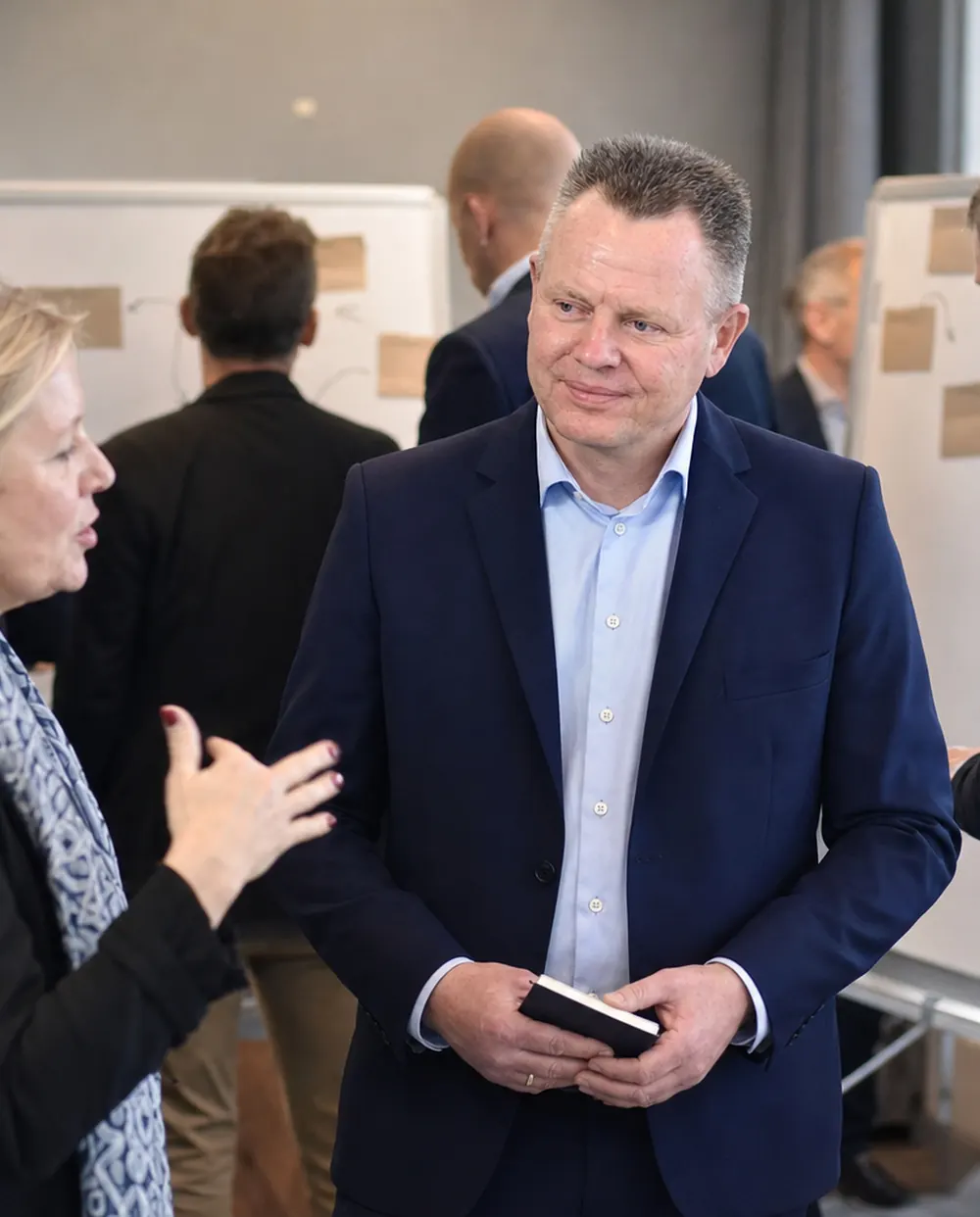
The room, the advisers' mandates and the chair's discipline were designed by Claus Dahlmann Larsen from more than 30 years in senior commercial roles. You drive the room yourself. When a decision needs to be worked through in person, a facilitated meeting can be arranged.
- International leadership experience
- Strategy and commercial excellence
- Organisation, execution and negotiation
Start with the decision
A critical decision deserves a better conversation.
If your leadership team is facing an important strategic or commercial choice, start with a confidential conversation about the decision, the context and what is at stake.
Use Decision Room when an important choice needs timely challenge. Bring us in when the leadership team needs an in-person facilitated discussion.